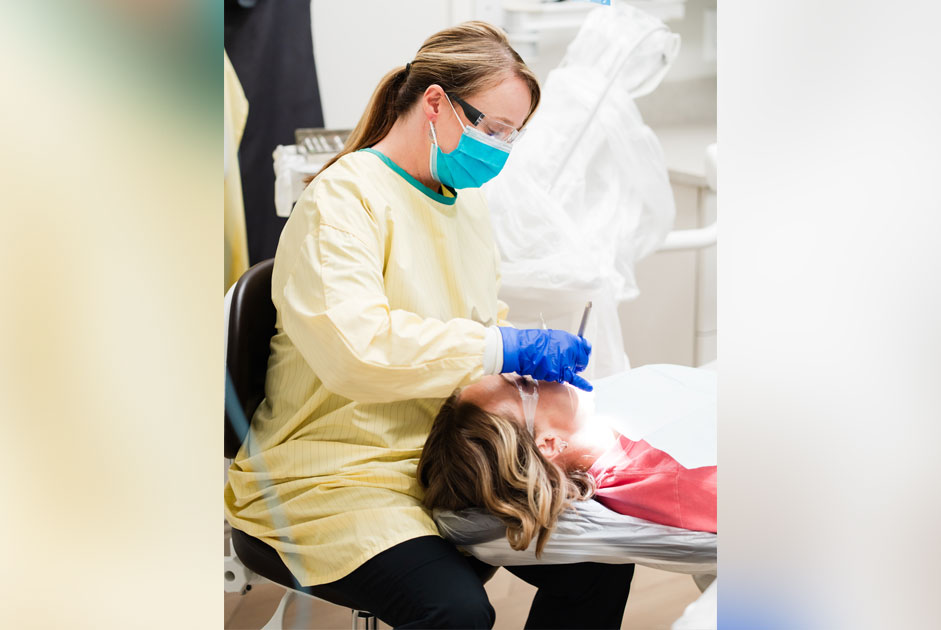
photos by: JODIE BRIM CREATIVE
By Dr. C. Richardson Daniel DMD, FAAHD, DABSCD
So here we are, writing about the “elephant” in this article — dental care and going to the dentist.
Some people love going to the dentist and are viewed as suspect by those who hate it. Some say they would rather have a baby — and that’s from the guys! Those who hate going to the dentist are an enigma to those who love it. Still others go to the dentist out of habit since childhood — which is a very good habit. Some patients only visit a dentist when there’s an emergency, and you know who you are!
For whatever reason you actually make it to that La-Z-Boy-style, very comfortable dental chair, you know those sounds, aromas, poking instruments, vibration, Niagara Falls amount of water, and suction that seems it could remove tonsils all come to mind. And that’s after the much-anticipated “numbing.” Then, of course, the involuntary nose itching.
Let’s think of each tooth as a small, individual person capable of copping an attitude or misbehaving with sensitivity and even pain, otherwise not working and playing well with others. Yes, other teeth may have had less, more, or similar treatment but never reacted the same way. Each tooth can be a good or bad actor, even after what can be thought of as a simple cleaning.
All of the above nuances of going to the dentist are just the tip of the iceberg. Most media commercials advertise the best brush, breath rinses, enamel hardeners, whitening products, adhesives, picket-fence perfectly aligned teeth, and a glorious smile. Nothing is wrong with the ads, as long as everyone understands there is more to oral health than what’s advertised. Oral care is required for oral health. And science is constantly revealing oral health is required for better health.
Oral care can be simple and not overly taxing — until it’s not. In healthcare, the proverb “the cure can be worse than the disease” can sometimes be true. When oral care becomes complex, there can be more discomfort, lack of function, and acute or chronic infections that can lead to increased morbidity or even mortality risk. Not all of us possess the same protoplasm, and even with the best oral care and achieving what one would consider great oral health, none of us are free from risks like trauma, tissue diseases, effects from certain medications, and oral cancer, to mention a few. The oral environment isn’t only teeth — it’s different types of oral tissues, taste buds, salivary glands and ducts, bone, muscles, ligaments, discs, nerves, and blood vessels. All can be affected by systemic health and changes, and they can influence and initiate systemic changes throughout the body. Not enough significance is placed on oral care being part of general medical care.
Based on observations made in the 1980s and the more robust scientific findings beginning in the 1990s, it’s abundantly clear that “Oral Care Leads to Oral Health and Oral Health Can Lead to Better Health®.” While reading all the science and studies might be riveting to some, to others such reading may be the unheralded cure for insomnia.
The national and international peer-reviewed, well-vetted studies, research, and findings have far exceeded what we thought or even envisioned years ago. There is now more clarity and evidence about the connections between inflammatory disease and subsequent systemic inflammation, systemic disease caused by or worsened by oral infection, and the association between oral, cardiovascular, and cerebrovascular health and oral pathologies and oral cancers.
Oral disease is one of the most prevalent diseases in the world and can be painful, disruptive, disfiguring, and complex. It can have a significant effect on one’s life from childhood through old age. The cost of treating oral disease is in the millions of dollars and reaching a billion dollars for emergency rooms, publicly funded programs, and individuals. Oral disease can cause any treatment to fail regardless of the expense and state-of-the-art treatment.
The message? Do what’s possible to prevent oral disease and its subsequent effects on your overall health and life. Oral care can lead to oral health, which can lead to better health.
If oral care is a habit — wonderful! If it is not, get started now!
Oral Care … for Better Health®
Oral Health … for Better Health®
(Officially Registered Trademarks of Dr. C. Richardson Daniel)
University Dental Associates offers hours Monday through Thursday, 8:00 a.m. – 5:00 p.m.; Friday, 7:00 a.m. – 5:00 p.m., and is available 24/7 for emergencies. To find a location or schedule an appointment online, visit udadentistry.com. University Dental Associates – Cloverdale is located at 2287 Cloverdale Avenue NW, Winston-Salem, 336.837.2680. Other Winston-Salem locations are at 1615 S. Hawthorne Road, 336.768.3454, and 2020 Village Link Drive, 336.923.4262. In Clemmons, find University Dental Associates at 6201 Town Center Drive, Suite 130, 336.778.9199, and 2311 Lewisville Clemmons Road, Suite 301, 336.631.4770.