Fast Food vs. Convenience Food
Fast food consists of meals prepared quickly at restaurants and purchased at drive-thrus or counters, focusing on speed, uniformity and immediate consumption outside the home – such as burgers, fries, pizza and fried chicken. Convenience foods include a wider range of timesaving options like pre-packaged, frozen or ready-to-eat items primarily from grocery stores that require minimal heating or assembling at home. Both types generally have lower nutritional value and higher caloric intake than home-cooked meals.
The History of the Fast Food Industry
The U.S. fast food industry as we know it began in the 1920s with White Castle, but truly exploded after World War II (1940s-1950s). It was fueled by a booming American economy, the rise of automobiles, suburbanization and changing family dynamics that required quick, affordable meals. With more people increasingly working outside the home, eating out shifted from being a luxury to a necessity. Fast food restaurants thrived by providing speedy, affordable meals that suited the needs of busy workers and families, leading to the rapid expansion of chains tailored for on-the-go lifestyles. By the mid-1970s, competition in the fast food sector intensified, sparking the so-called “Burger Wars” of the 1980s and 1990s. Restaurants responded by updating their interiors and introducing features like indoor seating and the now-famous drive-thru. To appeal to families, they developed special kid-friendly spaces and meal deals (themed, branded toys packaged with fast food). The industry continues to evolve. Today’s health-focused trends have led fast food chains to introduce menu options that are more customizable, cleaner, locally sourced and minimally processed.
Factors Driving Fast Food Popularity
- Meals ready in minutes, ideal for busy people and travelers.
- Convenient drive-thrus and widespread locations.
- Value meals often cost less than cooking at home.
- Foods engineered to trigger pleasure and cravings.
- Appealing textures (crunch), smells and colors.
- Deep cultural roots and heavy advertising.
- Variety, promotions and regional menu options.
- Fits modern, time-saving lifestyles.
- Sometimes seen as a fun, simple social outing.
Burger Origins – From Rome to the USA
The hamburger stands out as the quintessential fast food choice. Its origins are debated, with claims stretching from ancient Roman minced meat patties to “Hamburger Charlie” serving meat between bread at 19th-century fairs, to White Castle’s early 20th-century “slider” burgers. Regardless of its exact beginnings, the hamburger’s popularity soared in postwar America. By the late 1940s and early 1950s, burger restaurants were opening nationwide, including the now-famous McDonald’s, launched by Dick and Mac McDonald in 1948 in San Bernardino, California. By 1958, McDonald’s had sold 100 million burgers, revolutionizing American dining habits. Their success paved the way for other fast food chains, such as Burger King – proudly known as the “Home of the Whopper” – to enter and shape the market.
Forsyth’s First Fast Food Restaurant
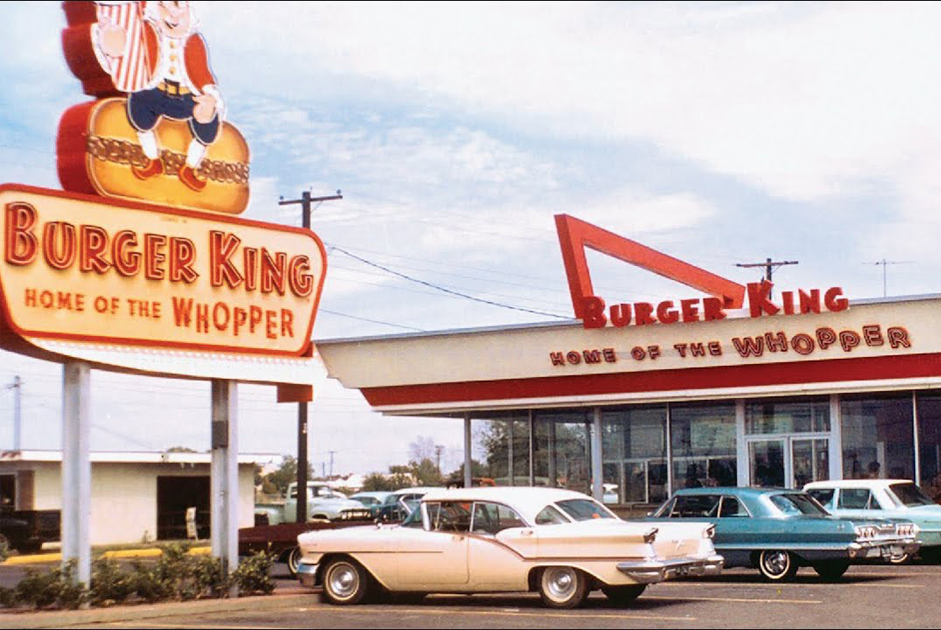
Burger King’s story in America began on December 4, 1954, when James McLamore and David Edgerton launched their first restaurant in Miami, Florida. The company’s roots trace back to 1953 in Jacksonville, where it was originally called “Insta-Burger King.” After reorganizing, McLamore and Edgerton expanded the brand nationwide, choosing the name “Burger King” to evoke a sense of quality and royalty. In 1957, they introduced the Whopper – a quarter pound, flame-grilled burger with all the fixings, priced at 37 cents – which quickly became their signature item, standing out against the smaller, less expensive burgers offered by competitors. By 1962, Burger King had grown into a national chain, thanks to a pivotal purchase by Miami franchisees in 1959. This expansion brought the Whopper and the Burger King experience to North Carolina, with the first location in the state opening on Peters Creek Parkway in Winston-Salem that same year. This restaurant, with the “Sitting King” logo, was part of the chain’s early growth in the southeast and marked Forsyth County’s introduction to fast food. The rest is a whopper of a successful fast food tale with more than 232 Burger King restaurants in North Carolina alone and more than 19,000 locations around the globe.