Winston’s Crowning Glory
While Winston-Salem now boasts many excellent hotels – like the Historic Brookstown Inn, Graylyn Estate and the Kimpton Cardinal Hotel – in the late 1800s, as tourism began to flourish, upscale accommodations for wealthy visitors were scarce. The city’s rapid growth, fueled by the booming tobacco industry, sparked a wave of development in the 1890s, with at least seven companies formed to take advantage of the construction surge. Among these was the West End Hotel and Land Company, led by tobacco magnate William A. Whitaker and a board of directors that included some of the area’s most influential industrialists including R.J. Reynolds, P.H. Hanes, James A. Gray and J.W. Fries. On May 29, 1890, they convened to plan a luxurious, state-of-the-art hotel that would further boost local tourism. By July 2, 1890, the company had acquired 180 acres on West Fourth Street (near present-day Grace Court on Glade Street) and envisioned a resort city crowned by a luxurious hotel atop one of Winston’s highest points.
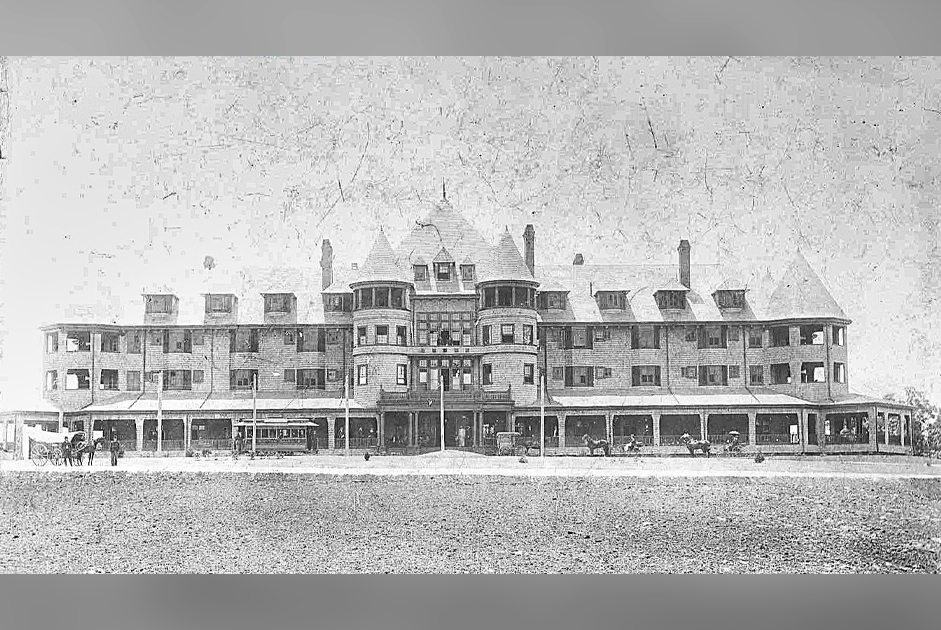
Construction of the Hotel Zinzendorf began in the spring of 1891, and by May 1892, the elegant four-story, shingle-style wooden hotel, with its expansive 18-foot-wide front porch, opened its doors. Perched on the knoll of West Fourth Street, 1,100 feet above sea level, the Zinzendorf was quickly hailed as one of the south’s finest hotels. Named for Count Nicholas Ludwig von Zinzendorf, who founded the Moravian settlement of Salem, the hotel instantly became the heart of Winston’s social scene, hosting meals, meetings, dances and parties. It was the place where everyone wanted to be seen.
A Night to Remember
Historical records offer a window into the vibrant social scene at the Zinzendorf Hotel around the turn of the century. One particularly memorable occasion was a Leap Year banquet, hosted by the affluent single women of Winston and Salem on Friday, November 18th. Forty-four prominent bachelors made their way together down Fourth Street to the hotel, where they were welcomed by 37 bachelorettes and about 30 chaperones – married couples, widows and widowers. Among the bachelors, Richard J. Reynolds, considered Winston’s most eligible bachelor, stood out as the oldest attendee at 42. Despite the festivities and plethora of available ladies, he left without a match and remained single for nearly 13 years before eventually marrying his 25-year-old first cousin once removed, Katharine Smith.
The Streetcar Legacy
In the late 19th century, Winston’s leaders established the Winston-Salem Street Railway Company. Known as one of the first cities in North Carolina to adopt electric streetcars, the system connected the formerly separate towns of Winston and Salem. The first streetcar line ran north to south from the courthouse in Winston, down Main Street, and through Salem. A second line extended west from the courthouse, reaching the newly constructed, three-story Zinzendorf Hotel. As time passed, the trolley system gave way to buses. After 46 years of service, Winston-Salem’s electric streetcar made its final journey on December 29, 1936. To commemorate the occasion, the Chamber of Commerce organized a “Romance of Transportation” parade, showcasing every conceivable mode of transit and gave residents a chance to bid farewell to the streetcars that had served the city since 1891. By September 1938, gasoline-powered buses had fully replaced the electric trolleys, and the last tracks were removed from city streets.
Rising From the Ashes
After a highly successful summer in 1892 at the Zinzendorf Hotel, disaster struck just months later on Thanksgiving morning. A fire ignited on the western side of the building, starting in the boiler and laundry rooms, and quickly spread to the dining hall. Fortunately, everyone escaped unharmed, and the staff even managed to rescue some of the furniture, sitting outside as they watched the flames consume the wooden hotel. Fire engines from both Winston and Salem rushed to the scene, only to find that the hydrants lacked sufficient water pressure to fight the blaze. Within two hours, the hotel was reduced to ashes, and with it, the aspirations of becoming a resort destination were dashed. However, in 1905, several of the original shareholders regrouped to form the Forsyth Hotel Corporation and announced plans for a new, six-story Zinzendorf Hotel on Main Street between Second and Third Streets – a project that was part of a broader urban renewal effort. The new Zinzendorf Hotel opened its doors in 1906, featuring 120 rooms, a lobby adorned with terrazzo floors and elegant English oak furnishings. It underwent expansion in 1917 and continued to serve guests until 1970. The following year, the hotel was demolished to make space for new development, and by 1976, a nine-story Federal Building stood in its place. This building was officially renamed the Hiram H. Ward Federal Building &