Roots of Visual Entertainment
Paul Ayers, as referenced in “WS Theater History,” notes that the area’s first public entertainment venue was located in the Sixth House, in Old Salem, just south of Fish Alley at Main Street. In 1843, several musicians requested permission from Moravian church leaders to convert one part of the building into a space for music practice and concerts. In time, this setting became known as the “music hall.” While the church elders imposed strict bans on what they considered frivolous activities, they did permit limited types of visual entertainment, many of which were lectures. It was Br. Christian Friedrich Sussdorf – a piano tuner and landscape gardener – who organized “picture shows” using a device called the “magic lantern.” Making their debut in the 17th century, magic lantern shows protected images – created from paintings, prints or photographs on transparent glass plates – onto walls using a combination of lenses and a light source – often kerosene – to project the photographic slides. These visual presentations typically featured stories with educational, humorous or moral themes and were enhanced with live music, narration and sound effects making for an immersive experience for the audiences. By the mid-19th century, “movie shows” had become pretty sophisticated, including triple lens projectors; and the popularity of the magic lantern remained well into the 20th century until it was eventually replaced by the slide projector.
Forsyth’s First Indoor Movie Theater
In 1903, the Winston Elks Club constructed an impressive $35,000 headquarters at 442 North Liberty Street that incorporated an auditorium especially adapted for stage productions, including 50-foot drops with a collection of generic stage backgrounds. The Elks Auditorium quickly earned a reputation as the finest theater between Washington, DC and Atlanta. Its grand opening on September 24th featured a vaudeville show that packed the house with more than 1,300 attendees and generated $1,100 in ticket sales. Over the following years, the Elks Auditorium became a popular destination for entertainers and eventually began showing moving pictures – illustrated songs. Tragically, a fire broke out in the early hours of April 27, 1916, causing such extensive damage to the building that it had to be torn down. The loss of the Elks Auditorium was deeply felt throughout the city, as it had been regarded as Winston Salem’s finest movie house.
Rebuilding, Renaming and the “Talkies”
After the Elks Club decided not to rebuild their original theater, Sams, Moses and their Piedmont Amusement Company – already owners of three downtown venues (Elmont est. 1912, Pilot est. 1913 and Broadway est. 1918) – constructed a modern, fireproof Auditorium Theater on the same site. The remarkable $100,000 building, with seating for 1,800, opened on January 28, 1918. About 10 years later, Winston-Salem experienced a cinematic revolution with the introduction of “talkies” – feature-length films with synchronized music and dialogue. On Christmas Day 1928, the Auditorium Theater debuted the “Photophone” system with the film “The Spieler.” This innovative technology developed by Alexander Graham Bell and his assistant, Charles Tainter, recorded sound directly onto film for improved editing and synchronization. Meanwhile, other local theaters – the Carolina and Colonial – adopted the competing “Vitaphone” sound-on-disc system, premiering their own first “talkies” soon after. Thanks to the Photophone’s industry-leading capabilities, the Auditorium became one of Winston-Salem’s longest running and most influential movie houses.
Time Marches On
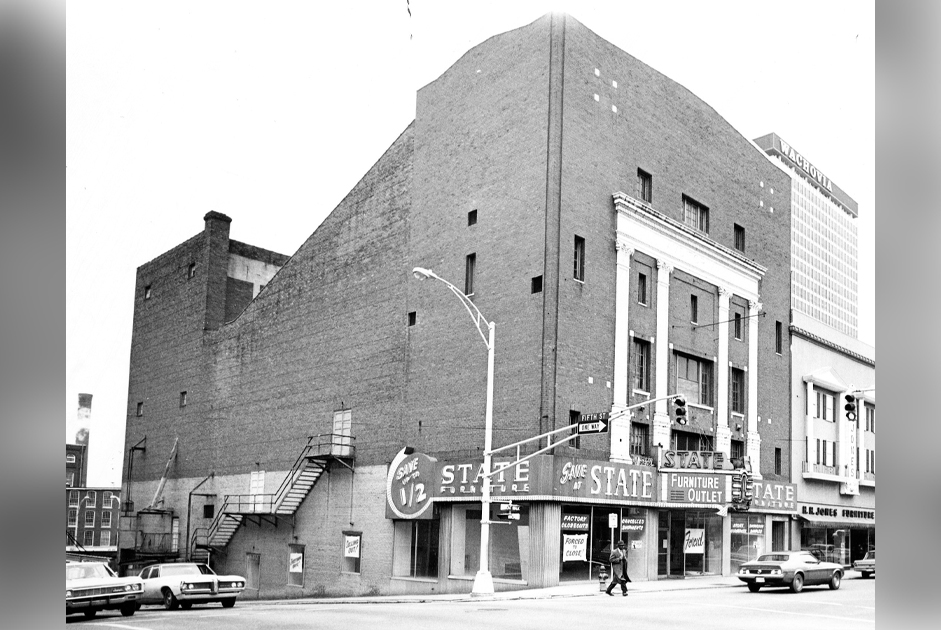
In time, Publix-Saenger acquired and renovated the Auditorium Theater and reopened it as the State Theater in 1930 with the premiere of “High Society Blues.” The State Theater flourished for almost 20 years, but its prominence began to fade after the Winston Theater opened at 635 West Fourth Street in 1949 – a shift that ultimately led to the State’s closure in 1952. The building briefly served as the State Furniture Company in 1956 before being demolished in the early 1970s. Over the course of 60 years, 442 North Liberty Street was home to two different buildings, three theaters and a furniture store; today, the site is occupied by a parking garage. All of Winston-Salem’s historic downtown movie houses have disappeared, leaving only one: a/perture cinema, which opened in 2010 at 311 West Fourth Street. This independent, locally owned art house theater seats 230 and hosts more than 4,000 screenings and special events annually, showcasing more than 250 films each year.
Photos I found while doing research: