On the Edge
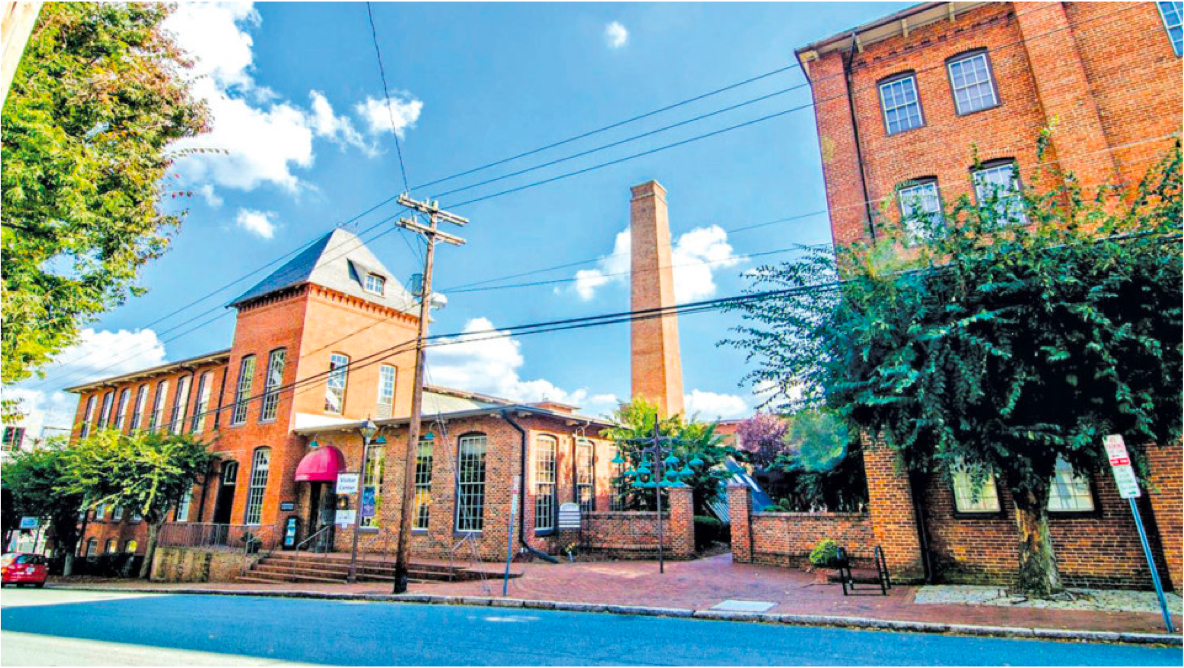
Fueled by the success of the booming tobacco and textile industries in the late 19th century, Winston experienced significant growth on the western edge of town. In 1890, Jacob Lott Ludlow, the city’s founding engineer, designed the West End neighborhood as Winston’s first true suburb, its layout guided by the streetcar lines. In contrast to the city’s grid pattern, Ludlow took advantage of the already dramatic topography in his design of curvilinear streets, terraced lawns and park areas. As one of North Carolina’s first charming streetcar suburbs, the West End remains a remarkably intact and authentic reflection of early suburban planning. Listed on the National Register of Historic Places, the West End preserves its original parks and tree-lined streets and showcases a blend of homes in styles like Queen Anne (e.g. Webb-Reece House and the Jacob Lott Ludlow House), and Neo-Classical Revival (e.g. Rosenbacher House and J. Cicero Tise House) alongside contemporary commercial development.
A Prominent Location
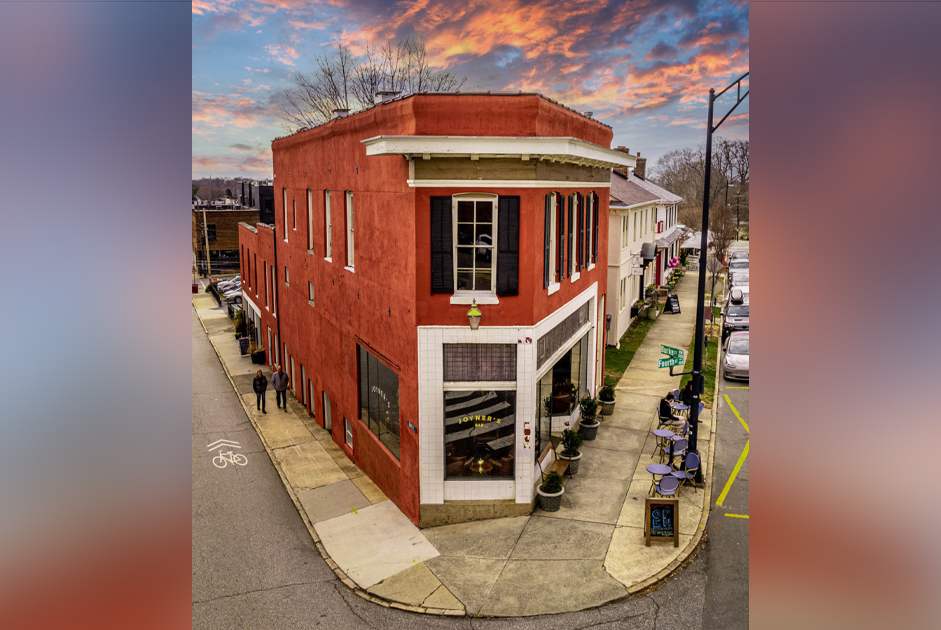
Formed from a branch of the “new” Shallowford Street – today’s First Street – Burke Street took shape as a vital thread in the fabric of the expanding West End. It was originally known as Burk’s Alley, named after Henry Burk (spelled without an “e”), who owned and farmed the land in that area. In 1891, with the opening of one small grocery store, the street quickly became a commercial hub in the West End of Winston. Burk’s alley eventually became known as Burke Street (the “e” was added to the street name in city directories in 1921). Frank Miller purchased the pie-shaped plot of land and modest wooden structure that sat on it from Burk, and his newly acquired tenant, John T. Joyner opened and operated the first grocery store in the West End. With impeccable timing and a prime location, Joyner’s success flourished from the start, and his rapid growth in clientele required more space to keep up with the increasing shopping demands. Miller, Joyner’s landlord, lived just a couple of blocks away on “Millionaire’s Row” (facing Summit Street at the corner of Fifth) and understood firsthand the seemingly overnight population explosion in the area. He proposed replacing the old wooden structure with a substantially larger two-and-a-half story brick building, expertly tailored to the lot’s irregular footprint on the same site and…build it in a remarkably short time. Though it was an ambitious task, Miller proved resourceful. He purchased the former Winston Male Academy, carefully deconstructed it, then transported each brick to the construction site – upcycling before its prime! The modest wooden structure was demolished in July of 1892 and, by the final week of the month, Joyner and his new wife, Phoebe, had moved into the striking new brick building. Phoebe set up house on the top level while Joyner busied himself on the main level, stocking the shelves to capacity. Just one week later, Joyner reopened and launched a series of newspaper ads to attract new West End customers and remained the area’s principal grocery for the next quarter of a century.
End of an Era
Joyner transferred his prime storefront to fellow grocer, R.B Crawford in the spring of 1916. Like its predecessor, the business flourished from the start and continued to serve the West End into the 1940s. The landmark building at 854 W. Fourth Street, once home to J.T. Joyner’s thriving grocery store, now serves as the wildly popular gathering place known as Joyner’s Bar. In the heart of the vibrant West End district, housed in one of the oldest and most significant historical buildings in the area, the two-and-a-half story flatiron pays tribute to the grocer who took a chance and paved the way for success 135 years ago. Fast forward to 2021 – the current owners (Herbie Gimmel, Wade Robinson and Joel Ornstein) transformed the building into an elegant cocktail bar with Prohibition Era flair, thoughtfully preserving its early 20th century architecture and vintage charm. Both the ground floor, which was once home to J.T. Joyner’s grocery, and the upstairs living quarters, where John and Phoebe raised their three children, welcomes customers to stop by and savor a reimagined classic cocktail such as the Black Gin Rickey or Oaxacan Negroni. As stated in the Winston-Salem Downtown Plans (2023), “the future of Downtown is a vibrant one filled with opportunities.” It will be interesting to see what the next chapter holds for this West End gem!